

We are pleased to share our "SDG Blue" methodology, our "rating" system to evaluate the potential of each investment to contribute toward the achievement of the United Nations' Sustainable Development Goals (SDGs).

Each investment in our portfolio, as it moves from origination to approval, is assigned a "shadow rating" from a credit perspective, similar to a credit rating given by a Moody’s or an S&P rating. Credit Ratings, as many of you know, have both quantitative and qualitative elements, as well as comparisons to established market benchmarks. We have learned from this approach, leaning on our internal expertise, and that within the membership of our Sustainability Advisory Committee and prominent sponsors, to develop a rating system for the SDGs.

As stated in our Sustainability Approach, Blue like an Orange is not simply “aligned” with the SDGs or “mapped” to them, but goes several steps further to determine at goal and target level, the impact each investment will have against each of the 17 Goals and the 169 Targets. Since UN indicators are not always applicable to our investments (often due to the public sector lens through which many of the targets and indicators were written), we have done our best to “translate” the indicators into something more applicable to the private investment space.
SDG Blue also takes a proactive and intentional approach with regard to impact. Meaning, we at Blue like an Orange have a point of view in terms of Goals on which we would aim to enable particular progress, given our sectoral focus and investment thesis. That is not to say that the other Goals would not be considered or are not important, but we have identified 4 Goals that are applied across every investment Blue like an Orange makes – job creation, gender equality, innovation, and environmental sustainability. SDG Blue uses 4 “Mandatory SDG Targets” and 4 “Elective SDG Targets”, selected by the investment team that are custom for each opportunity, making the tool clearly defined but flexible.
Each investment will be given an preliminary rating before a first Investment Committee meeting. The rating will be refined as the investment progresses through our approval process, and then be updated on an annual basis, and be presented alongside the commercial shadow credit rating.

To the extent possible, we have sought to minimize subjectivity in the rating process by standardizing the indicators used, building on the excellent work of groups like GIIN’s IRIS+. But, as with any evaluation methodology, it is impossible to eliminate this variable. In developing the tool, we opted for something that was “complicated enough” to be robust, but not so complicated and multifaceted such that the actual impact narrative is obscured.
As we have consistently applied the tool to our pipeline and portfolio, one particularly satisfying element we are discovering is how the rating generates a dialogue with our borrowers, and how it creates a platform on which we can have a substantive conversation on ways to improve impact.
While we feel this updated version of SDG Blue is more robust than the initial one, since we learned a lot from the 4 years of existence and application of SDG Blue, we are convinced it can and should still be improved. We will continue to refine and improve at as we apply it, and we encourage feedback from the sustainable and impact investment community. The tool is meant to be a contribution to the important dialogue around the Sustainable Development Goals, which in our view, is the most meaningful international commitment to improve our people and planet. We have ten years left to achieve them and look forward to continuing the conversation.

SDG Analysis
Blue like an Orange maps each potential opportunity against the Sustainable Development Goals (“SDGs”), assigning a score similar to a credit rating given by a Moody’s or an S&P rating.
The SDG mapping begins in the preliminary screening phase, in parallel to the commercial preliminary analysis of the opportunity. Each investment will be given an initial rating before a first Investment Committee meeting. The rating will be refined as the investment progresses through our approval process, and then be updated on an annual basis, and be presented alongside the commercial shadow credit rating.
More specifically on the scoring methodology, Blue like an Orange has selected “Primary Goals” that are applied to all opportunities; these SDGs are amongst those most commonly discussed in the development sector, and they are most likely to be addressed by the private sector; they include:
Goal# 8 (Job creation)
Goal# 5 (Gender equality)
Goal# 9 (Innovation)
Goal#12 (Environment)
“Primary Goals” are applied to all opportunities, but other goals used in the tool are elective, and are selected by the team on each opportunity.
For each SDG Target in the matrix below, the deal team evaluates the strength of the impact generated by the company in support of the Goal and assigns a numeric value.
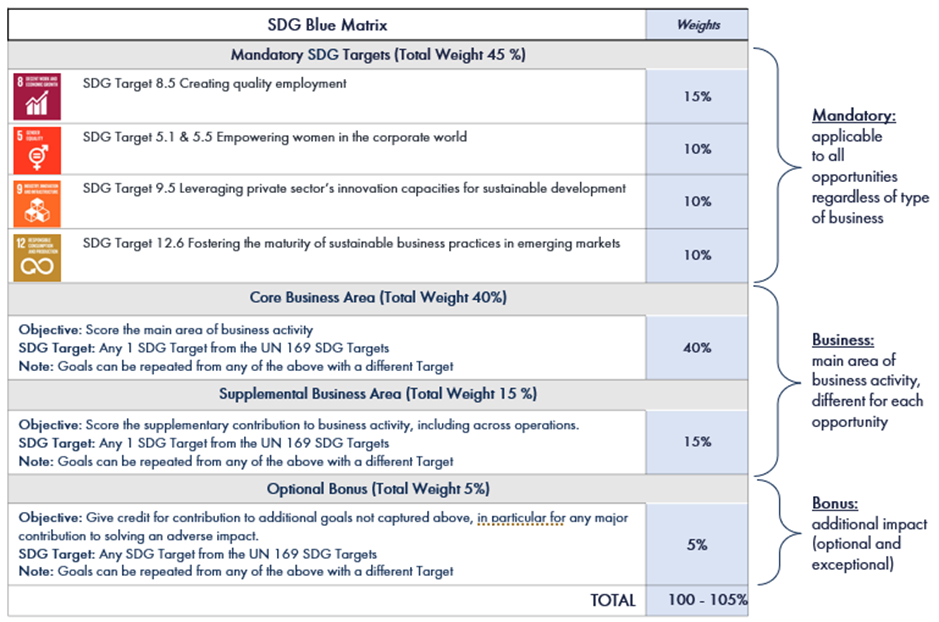
x
Scoring methodology
For each Goal/ Target, the deal Team evaluates the strength of the impact generated by the opportunity and assigns a numeric value, according to a specific methodology, as described in the complete Methodology document below; the scores are multiplied by weights.
SDG Rating
SDG Blue can have a score of 0-10. An opportunity needs to score a minimum of D (6.0) to be considered for investment. Companies rating B or more are considered as being high impact.